
 English
 简体中文
 Español
 Français
 Deutsch
 Русский
 Português
 Italiano
 日本语
 한국어
 العربية
 Türkçe
 Tiếng Việt
 ไทย
 Indonesia
 Melayu

Paper boxes are the most mature yet most easily underestimated category in packaging. It looks like just “paper + printing + gluing,” but a paper box goes through at least eight stages from base paper to shipment: base paper procurement, sheeting, printing, surface finishing, die-cutting, gluing, quality inspection, and warehousing/logistics. Cost fluctuations and lead-time risks at each stage cascade into the final quotation. This article breaks down the real structure of paper box manufacturing from a supply chain perspective and explains what Alibaba Gold Supplier certification actually means in procurement decisions.
1. The Four-Layer Structure of the Paper Box Supply Chain
Layer One: Base Paper and Paperboard Supply
Base paper is the biggest cost component. The prices of grey board (for rigid boxes and lidded boxes), white card (for folding cartons and cosmetic boxes), and corrugated board (for transport packaging) track pulp markets directly. Since 2025, domestic white card capacity has been highly concentrated, with top paper mills holding strong pricing power. Small and mid-sized box factories essentially have no pricing power over base paper. This means a box supplier’s margin depends heavily on purchasing scale and inventory management—whether they can lock in volume when paper prices are low, and whether they can secure payment terms from first-tier distributors, directly determines quotation competitiveness.
Layer Two: Processing and Printing
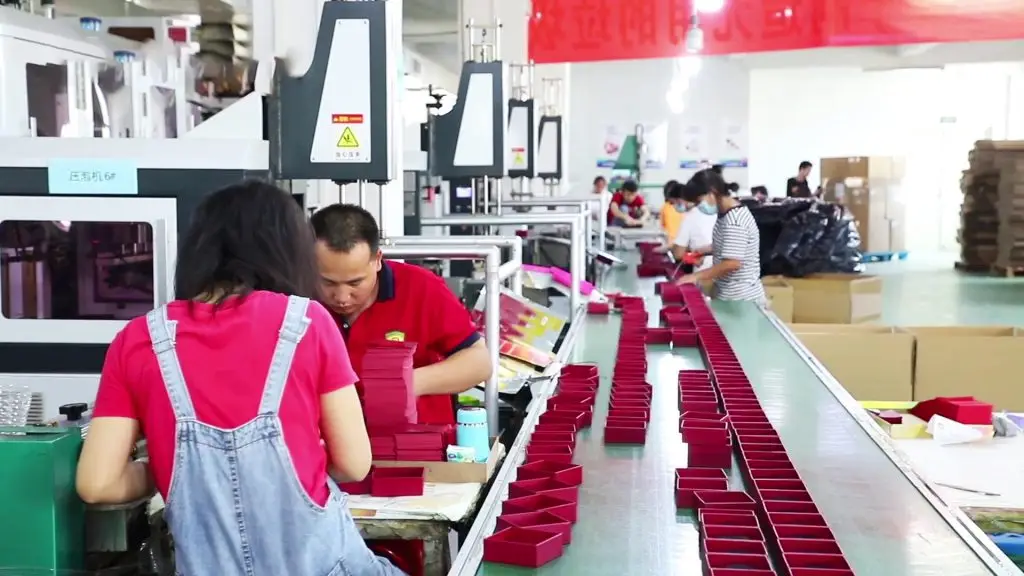
This is the core of a paper box factory. Printing (offset/flexo/digital), surface finishing (lamination, varnishing, foil stamping, embossing, UV), die-cutting, and gluing—each process’s equipment precision and yield rate determine unit cost. A common misconception is that “newer equipment is always better.” In reality, the match between equipment and order structure matters more: high-volume standard cartons suit high-speed offset presses with inline die-cutting, while small-batch custom-shaped boxes rely on semi-automatic equipment and skilled labor. Gluing especially tests experience—automatic gluers run standard box styles with high efficiency, but custom shapes, small sizes, and gift boxes with inserts often require manual or semi-automatic work, noticeably raising labor cost share.
Layer Three: Accessories and Components
Magnets, ribbons, EVA inserts, foam, PVC window film—rigid gift boxes involve many accessory types and dispersed suppliers. The difficulty in accessory procurement is not price but kit completeness rate. A gift box missing one ribbon means the entire batch cannot ship. Mature box factories build safety stock and backup supplier lists for accessories—this is the substantive gap between small workshops and established factories in delivery reliability.
Layer Four: Warehousing and Logistics
Paper boxes are classic bulky cargo—large volume, light weight. A 40HQ container filled with folding cartons might weigh only a dozen or so tons; space utilization is the key to logistics cost. If a box factory quotes only FOB unit price without a loading plan, the buyer may lose the margin on freight. Professional suppliers provide carton dimensions, units per carton, and 40HQ loading quantity at the quotation stage, and may even recommend flat-pack shipping to save space.
2. Alibaba Gold Supplier Certification: What It Verifies and What It Doesn’t
Alibaba’s Gold Supplier (high-tier certification) primarily audits business authenticity and operational stability: business license, corporate bank account, legal representative identity, operating premises, export qualifications, and platform transaction records. Passing certification means the company is a traceable entity with transaction backing within Alibaba’s system, reducing the risk of encountering a shell company.
But buyers must understand: Gold Supplier certification is not a product quality certification, nor a capacity certification. It verifies that “this company genuinely exists and operates normally,” not “what this company’s box yield rate is” or “whether it can deliver 5,000 custom gift boxes on time.” Certification is an entry ticket, not a guarantee.
For paper box procurement, the real value of certification is lowering due diligence cost: you don’t need to verify from scratch whether the counterparty is a real factory with export records. But the remaining key questions—material grade, printing precision, delivery commitments, batch consistency—still require samples, factory audits, and contract terms to lock down.
3. A Pragmatic Procurement Framework: Certification as Baseline, Three Things You Must Confirm Yourself
First, request the material list and supplier sources. Ask about the GSM and brand of grey board/white card (e.g., APP, Sun, Chenming), and whether FSC-certified. Factories willing to disclose material sources generally have more confidence in quality control.
Second, request physical samples of similar products and batch retention samples. Don’t rely only on “success case” photos—ask for physical items. Request samples from two different batches of the same box and compare color difference, die-cut edges, and glue joint strength. ΔE≤2 is professional grade; ΔE≤5 is the passing line.
Third, request the loading plan and a breakdown of lead time. Ask about the standard cycle from artwork approval to delivery, how capacity is allocated during peak season, and how accessory kit completeness is guaranteed. A supplier willing to break down lead time into “printing days, die-cutting days, gluing days, QC days” is more credible than one quoting a single “15 days” total.
Conclusion
The competitiveness of a paper box supply chain lies not in a single machine or process, but in the combination of four things: pricing power in base paper procurement, yield rate through process matching, delivery certainty via accessory kit completeness, and space utilization in bulky cargo logistics. Alibaba Gold Supplier certification solves the first-layer question of “whether this company is trustworthy”; the remaining three layers still require buyers to verify with samples, data, and contracts. Certification is the starting point, not the finish line.