
 English
 简体中文
简体中文 Español
 Français
 Deutsch
 Русский
 Português
 Italiano
 日本语
日本语 한국어
한국어 العربية
 Türkçe
 Tiếng Việt
 ไทย
ไทย Indonesia
 Melayu
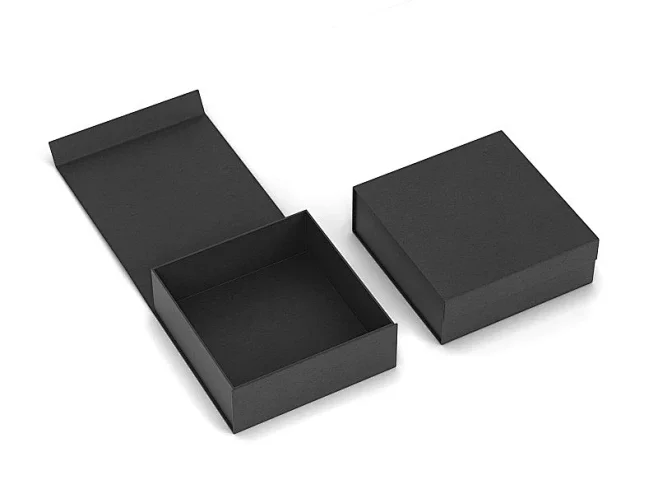
In the mass production and delivery of custom collapsible rigid boxes, many high-end brands face a common manufacturing challenge. Flat-packed newly produced collapsible gift boxes tend to show slight outward corner warping after terminal assembly, failing to achieve precise 90-degree flush closure. This subtle manufacturing defect undermines the display flatness of beauty, luxury accessory and premium gift packaging, and further causes magnetic alignment deviation and loose closure, greatly affecting the usability and texture of finished packaging. Most assembly inaccuracies and corner deformation are not caused by manual errors, but stem from the inherent paper memory effect of packaging substrates, a widespread technical flaw in standardized industrial production.
In precision packaging manufacturing, the paper memory effect refers to the inherent physical property of high-density greyboard. Thick greyboard adopted for collapsible rigid boxes and self-folding gift boxes features high hardness, excellent support and outstanding shaping stiffness, ideal for high-end customization. However, after long-term flat stacking, warehousing and transportation under continuous pressure, internal wood fibers build up directional elastic stress and permanently memorize the flat stretched state. When external pressure is released and the board is folded into shape, accumulated stress rebounds continuously and generates reverse tensile force, leading to outward corner warping, uneven gaps and irregular box shapes.
Most bulk quality issues share one core cause: production lines uniformly apply standard 90° V-grooving without differentiated parameter adjustment according to board thickness and fiber toughness. Fixed vertical grooves leave no buffer space for stress release, and mutual extrusion of groove walls during folding amplifies rebound deformation, resulting in a fixed 3° to 5° outward warping error. Meanwhile, traditional production only adopts ordinary double-sided tape for lamination. The low initial adhesive tack cannot offset long-term fiber rebound stress. Deformation deteriorates with static storage and ambient temperature and humidity changes, causing qualified prototypes but defective bulk products.
Focused on collapsible rigid box 90-degree closing failure caused by paper memory, our engineering team abandons traditional passive optimization methods. Centering on material mechanics and structural technology, we adopt multiple solutions including micron-level grooving calibration, structural optimization and stress preprocessing, thoroughly eliminating bulk defects such as corner warping, magnetic misalignment and irregular shaping with standardized precision manufacturing technology.
1. Core Precision Process for Anti-Warping Collapsible Rigid Boxes
- Substrate Pre-Stress Preprocessing: Before mass production, all high-density greyboard materials undergo constant temperature and humidity pre-folding calibration. Low-frequency repeated gentle folding disperses directionally accumulated fiber stress in advance, weakening the paper memory effect and avoiding rebound deformation caused by long-term flat storage.
- 93°-95° Micron-Level Overcut V-Grooving: Abandon universal standard 90° vertical grooving. Differentiated micro overcut V-groove angles are precisely matched for greyboard thickness ranging from 1.2mm to 3mm, reserving exclusive buffer space for fiber rebound and offsetting board elastic recovery force structurally to eliminate right-angle warping.
- Dual-Wall Mechanical Interlock Structure: Replace single adhesive bonding with foldable insert dual-layer mechanical interlock structure. Physical structure firmly locks folding angles without relying on adhesive viscosity, maintaining stable 90-degree right-angle shaping for a long time.
- High-Initial-Tack PSA Adhesive Adaptation: Industrial high-tack pressure-sensitive adhesive locks fiber stress instantly after lamination and fixes folding structures stably. The finished shape remains unaffected by temperature and humidity changes, long-term static placement and repeated opening and closing.
2. Performance Data Comparison: Traditional VS Precision Optimized Process
To quantify optimization effects, our engineering team conducted comparative tests under unified substrate, storage duration and assembly standards. All data fully conform to mass production scenarios, reflecting authentic process gaps and finished product stability.
| Evaluation Metrics | Standard 90° V-Groove Process | 93°-95° Micro-Overcut + Mechanical Interlock |
|---|---|---|
| Corner Closing Precision | 3°–5° warping gap with structural misalignment | Gap controlled within 0.5mm with perfect 90° flush fitting |
| Magnetic Structure Adaptability | Warped corners cause magnetic misalignment, suction drops by over 40% | Full wall flush contact, 100% magnetic alignment and firm closure |
| Terminal Assembly Efficiency | Requires repeated manual bending and correction with low efficiency | One-second pop-up forming, no manual correction required |
| Long-Term Storage Stability | Deformation aggravates after 15 days of flat storage | No obvious shaping deviation after 3 months of continuous flat stacking |
| Repeated Opening Durability | Loose folds and expanding gaps after multiple opening cycles | Stable right-angle structure after dozens of opening and closing cycles |
3. Core Engineering Parameter Specifications
V-groove depth is the key parameter to balance stress release and structural strength, serving as the core solution for collapsible rigid box alignment failure. To completely eliminate paper rebound defects while avoiding production flaws such as folding cracking and edge chipping, our engineering team adopts a fixed industrial golden grooving ratio: controlling grooving depth strictly at 65% of board thickness.
Take the conventional 2.0mm high-density greyboard as an example, the precise V-groove depth is calibrated to 1.3mm. The 65% grooving depth fully cuts off directional fiber stress inside the board and breaks paper elastic memory. The remaining 35% substrate thickness retains complete structural toughness, delivering ultra-flat 90-degree folding effects while ensuring tear resistance and bending resistance of folding edges. For customized boards with different thicknesses and densities, the team synchronously adjusts grooving angles and depths to achieve one-to-one technical adaptation.
4. FAQ
Based on massive mass production cases, we sort out high-concern technical questions from brand supply chain teams and provide targeted answers for paper memory and shaping deformation issues of collapsible rigid boxes.
Q1: Why do collapsible rigid boxes have perfect sampling shaping but corner warping in bulk flat shipments?
A: Sampling boards are placed for a short time without directional fiber stress accumulation, so no obvious paper memory deformation occurs. Bulk products undergo long-term stacking and long-distance transportation, leading to continuous stress accumulation. Traditional 90° V-grooving lacks stress compensation design and cannot offset rebound tension after shaping, resulting in batch corner warping and irregular right angles.
Q2: Can thicker greyboard solve incomplete 90° closure of collapsible gift boxes?
A: It cannot solve the problem fundamentally and may even aggravate deformation. Thicker high-density greyboard features stronger fiber toughness and higher elastic rebound force, leading to a more significant paper memory effect. Simply upgrading board thickness only improves box support without eliminating inherent stress. Optimized grooving technology and structural design are the essential solutions for paper memory rebound deformation in collapsible gift boxes.
Q3: Are there auxiliary shaping solutions for magnetic collapsible rigid boxes besides grooving optimization?
A: Pre-production substrate stress relief procedures can be added to eliminate flat-storage fiber memory. Local corner reinforcement technology is also available to lock box shapes structurally, double preventing magnetic misalignment and edge warping to meet high-end precision packaging standards.
Precision in mass packaging production determines terminal brand texture and delivery reputation. Standardized micron-level V-groove calibration, stress preprocessing and mechanical interlock structural optimization completely eliminate batch shaping defects caused by paper memory. Collapsible rigid boxes can maintain the cost advantages of flat transportation and storage while achieving high-end premium shaping effects, fully adapting to long-term bulk customization demands of various luxury brands.