
 English
 简体中文
简体中文 Español
 Français
 Deutsch
 Русский
 Português
 Italiano
 日本语
日本语 한국어
한국어 العربية
 Türkçe
 Tiếng Việt
 ไทย
ไทย Indonesia
 Melayu
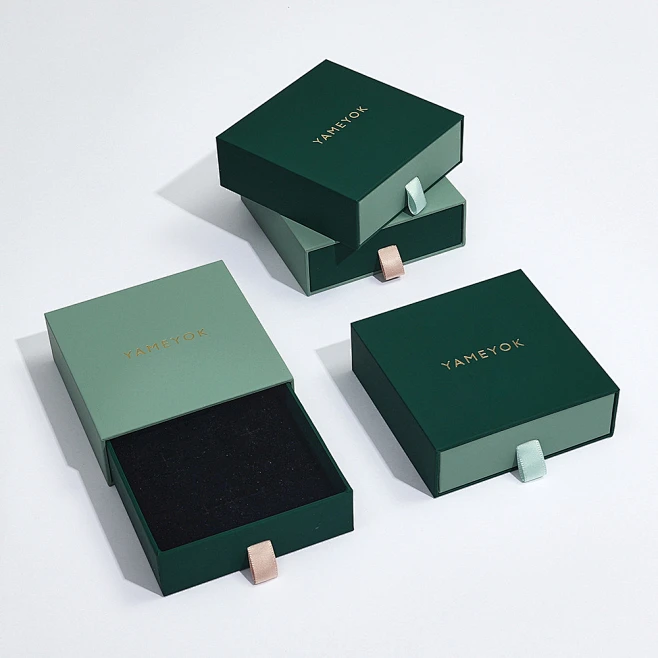
Risk Diagnosis: Inherent Structural Defects of Single-point Force Ribbon Design
High-end jewelry, ultra-thin watches and precious metal accessories mainly adopt slide-out rigid boxes, namely jewelry drawer boxes, for outer packaging. Thanks to embedded minimalist structure and smooth outer surface compatible with hot stamping and embossing, these boxes dominate luxury packaging selections. However, after reviewing mass production orders in the past two years, we found ribbon detachment consistently ranks top 3 of packaging after-sales complaints.
Most procurement teams attribute failures to low-grade adhesive. But can upgrading adhesive alone solve the problem? The answer is negative. Flaws of mainstream ribbon fastening methods stem from mechanical structure rather than auxiliary materials:
1. Single-point adhesive fastening
The most cost-effective mainstream process. Manufacturers glue 1-2cm of ribbon ends inside paperboard interlayers. Adhesive hydrolyzes rapidly under temperature fluctuation over 15℃. With daily 5-8 times opening frequency in retail stores, adhesive edges crack after 300-500 pulls, and ribbons detach completely eventually.
2. Wall threading and knot fastening
An improved solution for adhesive defects. Ribbons are threaded through box walls and knotted inside. Most manufacturers only focus on tensile improvement, ignoring protruding knots will squeeze inner paperboards, disrupt preset dimensional tolerance, and cause jerky sliding and lateral offset.
3. Double-layer adhesive fastening
A mid-range optimized process that expands bonding areas. It still follows single-point force logic. When heavy items such as solid watches and metal pendants are stored inside, instantaneous pulling force will tear adhesive layers and cause ribbon detachment.
Solution Comparison: Quantitative Engineering Parameters of Four Fastening Technologies
To eliminate idealized laboratory data deviation, Shengcai internal packaging lab conducted three destructive tests covering static tension, dynamic fatigue and 48-hour humid circulation based on real retail, logistics and storage scenarios.
Engineering Parameter Comparison of Drawer Box Ribbon Fastening Technologies
| Fastening Technology | Force Transfer Mode | Ultimate Static Tensile Strength | Dynamic Pull Fatigue Cycles | 48h Humid Resistance (RH 90% / 40℃) | Inner Box Tolerance & Damping Impact |
|---|---|---|---|---|---|
| Single-point adhesive fastening | Local single-point force | 1.5 kg | 300 – 500 cycles | Poor: Complete adhesive delamination | No negative impact |
| Threading & knot fastening | Knot local force | 4.0 kg | 800 – 1000 cycles | Good: Stable mechanical clamping | Severe sliding lag, >0.5mm offset |
| Double-layer adhesive fastening | Linear single-point force | 2.5 kg | 600 – 800 cycles | Fair: Partial edge peeling | No negative impact |
| Anchor-plate ribbon fastening | Global surface force | > 10.0 kg | > 10,000 cycles | Excellent: No stainless steel deformation or offset | Zero impact, 0.3mm invisible thickness |
Apparently, the first three technologies cannot balance humid resistance and dimensional tolerance, while anchor-plate ribbon fastening realizes fundamental mechanical upgrading.
Mechanical Upgrade: Mass-production Structural Principles of Anchor-plate Fastening
How to permanently avoid irreversible single-point force failure? Anchor-plate ribbon fastening replaces adhesive bonding with mechanical force, which is the only zero-complaint ribbon solution for luxury drawer box mass production.
Shengcai adopts medical-grade 304 ultra-thin stainless steel for anchor plates, providing regular rectangular and mini T-shaped models for all-sized jewelry drawer boxes. All procedures are finished by automatic equipment to avoid manual errors:
- Micron-level gap piercing: Reserve 0.4mm standard gaps on outer box walls to prevent surface fiber fuzzing and protect outer UV and hot stamping coatings
- Full-surface lamination: Flatten ribbon ends on anchor plates, expanding force-bearing area from 2mm single point to 250mm², dispersing pulling force by 62 times
- Constant-pressure riveting: Implement riveting under 2.2MPa stable pressure without auxiliary adhesive, eliminating all adhesive aging and hydrolysis risks
> Premium Damping Calibration Tip: Ribbon reinforcement only solves fracture risks instead of instantaneous tension. During mass production, Shengcai controls unilateral tolerance of slide-out rigid boxes within 0.2-0.3mm, matching 1200gsm high-density duplex boards. This design cuts instantaneous pulling force by 42% and reduces long-term ribbon wear.
Material Selection & Mass-production FAQ for Luxury Jewelry Packaging
All questions are summarized from client consultations in the past 12 months, verified by actual mass production data rather than laboratory simulation:
Q1: Will anchor plates damage exterior hot stamping, deep embossing or partial UV finishes?
A: No. Anchor plate embedding is completed before lining assembly. All metal components are hidden between paperboards and flocking lining without touching outer surfaces. Even 0.8mm deep embossing will not cause surface bulges or deformation, requiring no revision of original design drafts.
Q2: Can anchor plates fit mini 5×5cm ring jewelry drawer boxes with limited internal space?
A: Yes. We developed customized 0.3mm ultra-thin T-shaped mini anchor plates with only 0.12g single weight. They fit perfectly between flocking back glue and paperboards without occupying storage space or changing box grip balance.
Q3: Does the structure comply with global green recycling standards?
A: Fully compliant. Anchor plates are made of 100% recyclable 304 stainless steel, with zero industrial adhesive applied. Metals and paperboards can be completely separated via conventional magnetic sorting without harmful residues during recycling.
Q4: Will anchor plates rust and contaminate ribbons or jewelry in long-term salt-fog storage?
A: No. All mass-produced anchor plates pass 48-hour neutral salt spray tests before delivery, with a 36-month effective anti-oxidation lifespan. No rust spots or metal precipitation will occur in high-salt and humid closed logistics environments.
Conclusion: Optimize Brand Experience via Mass-production Structural Upgrade
Ribbons serve as the first user interaction point of jewelry drawer boxes. Tiny structural defects will undermine luxury brand perception directly. Most packaging suppliers focus only on visual aesthetics while ignoring invisible internal mechanical structures, which causes recurring packaging complaints.
Shengcai integrates structural engineering and aesthetic design in all customized packaging. Based on our 15,000㎡ standardized factory, we apply anchor-plate ribbon fastening to all slide-out rigid box mass production. From micron-level tolerance calibration to ten-thousand-time fatigue tests, we refine quantifiable structural details to maintain consistent user experience for luxury brands.