
 English
 简体中文
简体中文 Español
 Français
 Deutsch
 Русский
 Português
 Italiano
 日本语
日本语 한국어
한국어 العربية
 Türkçe
 Tiếng Việt
 ไทย
ไทย Indonesia
 Melayu
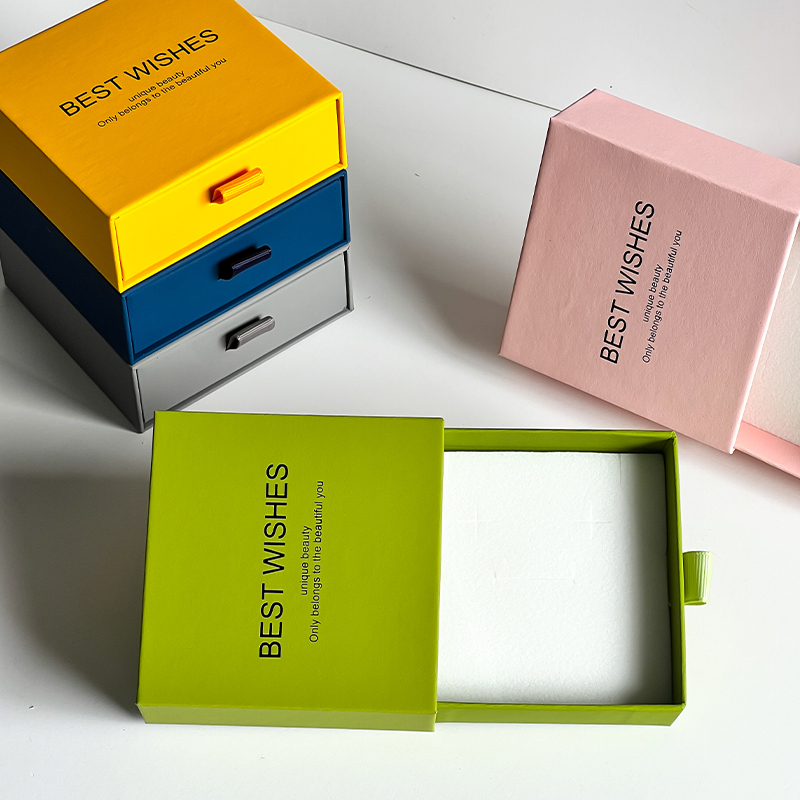
A well-crafted Jewelry Drawer Boxes is the core carrier for light luxury jewelry brands to convey texture and strengthen user memory points. From the damping feel when pushing and pulling, to the smoothness of pulling the ribbon handle, to the wrapping protection of the velvet inlay, every process detail directly affects the brand’s value positioning in the user’s mind. Let’s be honest, the Jewelry Drawer Boxes that can really retain users always rely on the process polishing in the details, not the superficial visual gimmicks.
Why Do Jewelry Boxes Get Stuck When Pushed and Pulled? Analyze the Engineering Logic of 0.2mm Golden Tolerance
The hand feel when opening the jewelry box is the first experience node for users to contact the product, and the core of the hand feel comes from jewelry drawer box tolerance precision control. Many brands have encountered such troubles: the jewelry box opens and closes smoothly when it is first produced, but after transportation or storage for a period of time, it becomes stuck, difficult to push and pull, and even the outer box tears. In fact, these are all caused by inadequate tolerance control.
After tens of thousands of opening and closing tests and mass production verification, the golden range of inner and outer box tolerance for light luxury jewelry drawer boxes is stably between 0.2mm and 0.5mm. The setting of this value contains very practical engineering considerations. When the tolerance is lower than 0.2mm, the cardboard will have slight expansion due to changes in temperature and humidity, especially in the high humidity and temperature difference environment during long-distance transportation, which can easily lead to stuck opening and closing of the box body, and the after-sales rate will increase by more than 8%. When the tolerance is higher than 0.5mm, the box body gap is too large, the damping feeling is completely lost, there is no smooth paragraph feeling when pushing and pulling, and the inner box will slide freely during transportation, repeatedly hitting the outer box, which will wear the printing surface at least, and cause the inner tray to shift and directly damage the jewelry at worst.
A qualified damping design must meet these three basic standards:
- When pulling the ribbon at a uniform speed with one hand, the inner box can smoothly slide out 2/3 of the whole journey without jamming or sudden stop
- When the box body is inclined at 45°, the inner box will not slide down by its own weight
- After 1000 cycles of opening and closing tests, the tolerance change does not exceed 0.1mm, and the damping feeling has no obvious attenuation
Completely Solve Ribbon Handle Degumming: Comparative Test Between Base Embedding Process and Perforation Rebonding
The ribbon handle is the core functional component of Jewelry Drawer Boxes, not just a decorative visual embellishment, but also determines the user’s opening and closing experience. We have seen too many brand gift boxes that have degummed handles and frayed cuts after less than ten uses, and the original high-end texture is completely gone. Even the handle falls off, leading to user complaints and affecting brand reputation.
For the two mainstream reinforcement processes in the industry, we have carried out a full-process limit test in a constant temperature and humidity environment. The test standard is to simulate the daily use force, a single pull stroke of 10cm, and a uniform speed of 30 times per minute. The final results are clear at a glance:
| Process Type | Pulling Resistance Limit Test | Anti-aging Performance | Appearance Integrity | Mass Production Rework Rate | Core Applicable Scenarios |
|---|---|---|---|---|---|
| Perforation Rebonding Process | Degumming and loosening occur after 320 uniform pulls | Easy to yellow at the ribbon edge and adhesive aging after more than 6 months | Ribbon joints are exposed, and the edge is easy to warp | About 8.7% | Disposable gift boxes, limited edition gift boxes for low-frequency use |
| Base Embedding Process | No loosening or displacement after 580 uniform pulls | No aging or yellowing after more than 12 months | Joints are completely hidden in the inner box base with no traces on the surface | Within 0.8% | Daily wear jewelry storage, light luxury gift boxes for high-frequency daily use |
To be honest, although the base embedding process has higher requirements for production accuracy, it can fundamentally solve the degumming problem. We have taken this process as the standard configuration for light luxury jewelry boxes on Shengcai’s mass production line. For the most concerned ribbon handle anti-fraying process, we have also achieved a standardized solution in mass production – dual treatment of high-temperature hot cutting edge sealing + invisible thread fixing, which completely eliminates fraying and burrs.
Protect Jewelry from Chemical Corrosion: Why Do We Insist on Using Environmentally Friendly Water-based Backing Adhesive?
In fact, 90% of the after-sales problems of jewelry boxes come from the process defects of the velvet inlay. Many users report that after using the jewelry box for a few months, the velvet surface becomes hard and caked, and even leaves glue marks and scratches on the surface of silver jewelry and pearls. The root cause lies in the velvet inlay bonding process and backing adhesive selection. Among them, the choice of backing adhesive is directly related to the safety of jewelry, which is also a point that we Shengcai have always attached great importance to.
To avoid glue overflow or penetration into the velvet surface, the core lies in the accuracy of glue control. The disadvantages of manual glue brushing are very obvious: the thickness is uneven, and it is easy to accumulate glue in the special-shaped grooves for rings, earrings and necklaces, with a glue overflow rate as high as 12%-15%. Once the glue penetrates into the velvet surface, it will cause the velvet surface to harden, and the entire inlay will be directly scrapped. The precision glue dispensing process for special-shaped jewelry box inlays relies on an automatic glue dispenser to achieve 0.1mm level glue output accuracy, which can accurately match the glue dispensing path of special-shaped grooves, and the glue overflow rate can be controlled within 0.3%. At the same time, the bonding strength is 40% higher than that of manual glue brushing, and there will be no falling off of the inlay at all.
For high-priced South Sea white pearls or 18K gold jewelry, we strongly recommend choosing 3.8mm or more long-pile microfiber and matching acid-free paper base material. This is because the residual acidic substances in ordinary cardboard may cause metal oxidation in a humid environment, while microfiber material can provide better chemical inert protection, which can not only firmly wrap the jewelry, but also avoid chemical reactions between materials, maximize the protection of the original luster of the jewelry, and extend the storage time of the jewelry.
In the anti-oxidation selection of jewelry box velvet inlay, the performance gap between different velvet materials and backing adhesives is far greater than you think:
| Material Type | Anti-oxidation Performance | Anti-scratch Performance | Wrapping Fit | Applicable Jewelry Types | Backing Adhesive Selection Suggestion |
|---|---|---|---|---|---|
| 3mm Long-pile Velvet | Excellent: The velvet surface can completely wrap the jewelry, isolate more than 90% of air contact, and delay the oxidation and blackening of silver jewelry | Excellent: Long pile can buffer friction and will not scratch the surface of precious materials such as K gold, pearls and South Sea white pearls | Excellent: Can perfectly fit the radian of special-shaped jewelry without shaking gap | Light luxury daily styles, high-value jewelry styles | Environmentally friendly water-based backing adhesive, non-corrosive, no harmful substances precipitation |
| 1.5mm Short-pile Velvet | Average: The velvet surface is thin, cannot completely isolate the air, and is prone to oxidation traces after long-term storage | Average: Short pile has weak cushioning performance, and the sharp jewelry edge is prone to velvet wear | Average: Only suitable for regular-shaped jewelry, special-shaped styles are prone to shaking | Entry-level jewelry, disposable gift sets | Water-based hot melt adhesive, controllable cost and stable performance |
| 3.8mm Long-pile Microfiber | Excellent+: Strong chemical inertness, completely isolating air and acidic substances, preventing jewelry oxidation | Excellent+: Fine and soft fibers, no sharp burrs, providing ultimate protection for precious jewelry | Excellent+: Far better fit than ordinary velvet, suitable for all types of special-shaped high-end jewelry | High-end jewelry styles such as South Sea white pearls and 18K gold | High-purity environmentally friendly water-based backing adhesive, odorless, non-corrosive, suitable for high-end needs |
Many people ignore the corrosiveness of the backing adhesive. Although oil-based backing adhesive has strong initial adhesion, it will slowly precipitate harmful substances, which will not only harden the velvet, but also corrode the surface of silver jewelry, and even leave unremovable marks on the surface of pearls. This is the core reason why Shengcai uses environmentally friendly water-based backing adhesive in all jewelry box customization – to ensure process texture and protect the safety of jewelry.
Core Process Standards: Shengcai Jewelry Box Quality Benchmark Table
The quality of craftsmanship ultimately depends on standards. We have sorted out the core comparison between Shengcai’s light luxury jewelry boxes and industry general standards. Every improvement in standards is to achieve better user experience and product texture:
| Key Processes | Industry General Standard | Shengcai Light Luxury Standard | Impact on User Experience |
|---|---|---|---|
| Inner and Outer Box Tolerance | 0.8mm – 1.2mm | 0.2mm – 0.5mm | Determines the “damping feeling” and smoothness when pushing and pulling, avoiding jamming or loosening |
| Ribbon Handle Resistance | ≥ 2kg Constant Tension | ≥ 5kg Constant Tension | Ensures that the handle does not fall off or loosen during high-frequency use, extending service life |
| Adhesive Type | Industrial Solvent-based Glue | Environmentally Friendly Odorless Water-based Backing Adhesive | Protects pearls and silver jewelry from corrosion by chemical volatiles, safeguarding jewelry safety |
| Inlay Glue Overflow Rate | ≤ 5.0% | ≤ 0.3% (Automatic Glue Dispensing) | Ensures the velvet feels soft, not hard or caked, improving user experience |
Frequently Asked Questions
In the process of serving tens of thousands of custom projects, we have sorted out the core questions most frequently asked by brands. Each answer is a summary based on our years of mass production experience:
- How to prevent fraying at the cut of the ribbon handle?
The most reliable solution is the dual treatment of high-temperature hot cutting edge sealing + invisible thread fixing. High-temperature hot cutting can instantly lock the ribbon fiber without loose threads, and then invisible thread fixing treatment is done at the cut. Even after thousands of pulls and frictions, there will be no fraying or burrs. We have achieved full-process standardization of this process on Shengcai’s mass production line without additional cost. - How to improve the thick and solid feel of the drawer box without increasing the cost?
There is no need to blindly increase the weight of the cardboard. Two small optimizations can be achieved: one is to optimize the corrugated structure of the cardboard, replace ordinary corrugated with high-strength corrugated, and improve the stiffness of the box without increasing the weight; the other is to do double-layer edging treatment on the edge of the inner box, which can not only improve the impact resistance of the edge, but also make the hand feel more solid and thick. The cost is almost unchanged, but the texture is significantly improved, which is also the preferred optimization plan for many light luxury brands. - What is the minimum order quantity for customized Jewelry Drawer Boxes?
We understand the different needs of brands in different development stages, so we have set a very flexible order standard. Conventional styles can be ordered from 500 sets, and the minimum order quantity for high-end styles such as 3.8mm long-pile microfiber can be negotiated. It can fully meet the trial production needs of new brands, or small-batch production of limited editions for mature brands, balancing flexibility and cost-effectiveness. - Can I make a sample for confirmation before mass production?
Of course. Shengcai provides free sampling service for all customized orders. You can first confirm the size, structure, printing effect and process details of the box, and even complete the whole process test of opening and closing, pulling, as well as test the protection effect of the inlay on jewelry. After all details are confirmed, we will proceed to mass production, with one-on-one follow-up throughout the process to ensure zero deviation between mass production and samples. - Are there any additional suggestions for material selection when customizing high-end jewelry drawer boxes?
If it is suitable for high-end jewelry such as South Sea white pearls and 18K gold, in addition to choosing 3.8mm or more long-pile microfiber and acid-free paper base material, you can also match the matte scratch-resistant outer box material to avoid scratches on the outer box affecting the overall texture; at the same time, you can add independent partitions in the inlay to avoid mutual friction and scratching between jewelry. Although these details are small, they can greatly enhance the high-end tone of the brand.
To be honest, a good set of Jewelry Drawer Boxes is never a simple storage container, but the first contact point between the brand and the user, and a concrete expression of brand value. With 25 years of experience in custom packaging production, a 15,000 square meter modern production workshop, and more than 200 professional technicians, Shengcai can provide you with one-stop custom services from structural design, sampling testing to mass production delivery. Whether it is creative design of special structures, standardized mass production, conventional light luxury styles, or high-end jewelry custom styles, you can find a suitable solution. We use process details to help brands convey high-end texture.