

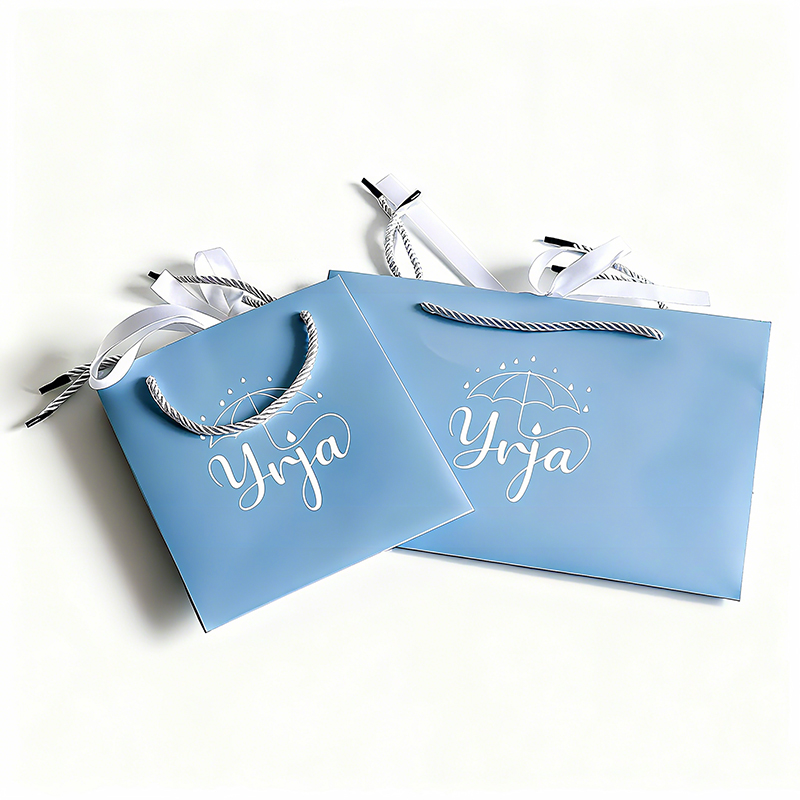
Practitioners engaged in high-end brand packaging are well aware that once high-end luxury paper bags adopt thick base paper of 250g and above, they will face the dilemma of exquisite appearance but poor durability. In daily storage, gift box packaging and long-distance transportation, the repeatedly folded edges often suffer from surface cracking, paper wrinkling and whitish crease marks, which directly damage the overall brand style. Are heavy and stylish 250g thick luxury paper bags doomed to fail in balancing folding resistance and appearance texture? After years of deep engagement in the industry, we find that the problem never lies in paper grammage, but the lack of mature pre-creasing anti-wrinkle technology as the core support.
Physical Principle Behind Folding Cracking of Thick Paper Bags
Most packaging buyers only notice the surface defect of crease cracking, without understanding the principle of internal fiber stress. Thick paper over 250g features compact fiber arrangement and strong paper rigidity. When folded at a right angle, the outer fibers are stretched forcibly while the inner fibers are squeezed and curled. Without pre-set crease guidance, once the local stretching range exceeds the bearing limit of fibers, fracture and edge cracking will occur, forming irreversible stubborn creases over time. This is why anti-cracking technology for folded thick paper bags has long been a tough challenge in the packaging industry.
Core Factors Causing Crease Cracking of Thick Paper Bags
- Fiber length and grade of base paper
- Matching precision of groove width and depth of pre-creasing male and female molds
- Real-time control of temperature and humidity in production workshops
- Ductility parameters of later film lamination and matte varnish coating
- Natural relaxation buffer time of paper after creasing
- Paper pre-treatment measures in extreme climate environments
2026 Latest Pre-Creasing Mold Adaptation Parameter Table for Thick Paper
Based on years of actual measurement and calibration data from Shengcai production line, paper bags with different grammages require strict crease specifications. Random parameter matching will only increase defective products, especially for high-end luxury paper bag customization, each set of parameters has been repeatedly verified:
| Base Paper Grammage | Standard Crease Width | Standard Crease Depth | Adapted Male and Female Mold Type | Applicable Scenarios |
|---|---|---|---|---|
| 250g–300g | 1.2–1.6mm | 0.3–0.45mm | Light fine grain mold | Light luxury accessories, small beauty gift box paper bags |
| 300g–400g | 1.6–2.2mm | 0.45–0.65mm | Medium universal mold | High-end skin care, watch gift box matching paper bags |
| Over 400g | 2.2–2.9mm | 0.65–0.85mm | Heavy deepened mold | High-end jewelry, luxury ready-to-wear gift box paper bags |
Paper Selection: Huge Gap in Anti-Wrinkle Performance
In most cases, many people overlook the impact of base paper material on crease durability, especially for high-end luxury paper bags. Minor differences in material selection will be directly reflected in the folding resistance and texture of the final product. The intuitive comparison below fully reflects the importance of material selection:
| Paper Type | Fiber Toughness | Folding Anti-Cracking Ability | Adaptation Effect of Luxury Paper Bag Crease Shaping Technology | Applicable Scenarios |
|---|---|---|---|---|
| Long-fiber wood pulp paper | Excellent | Extremely Strong | Neat creases, no whitening or cracking, maintaining texture after repeated folding | Mid-to-high-end luxury paper bag customization |
| Ordinary recycled mixed paper | Average | Weak | Prone to wrinkling and edge cracking after repeated folding, with obvious whitish creases | Ordinary packaging paper bags, not suitable for high-end customization |
| Long-fiber recycled wood pulp paper | Good | Strong | Relatively neat creases, no obvious defects after a small number of folds | Eco-friendly mid-range luxury paper bags |
Premium custom long-fiber wood pulp paper bags combined with precise pre-creasing can reduce fiber pulling caused by folding from the base material level, which is why high-end packaging always prefers this type of base paper. Shengcai strictly controls the material selection process, giving priority to long-fiber base paper that meets high-end customization standards, reducing the risk of crease cracking from the source.
Auxiliary Support of Environmental Humidity & Surface Technology
Workshop humidity quietly affects the flexibility of paper fibers. Years of production tests prove that when the workshop maintains a relative humidity range of 46%–58%, the toughness of thick paper fibers stays at the optimal state. It will not become brittle and crack due to dry air, nor soften and lose stiffness due to excessive humidity. This is one of the core details that Shengcai has strictly controlled in the production environment over the years.
Subsequent surface treatment acts like an elastic protective layer for paper bags. Anti-wrinkle lamination treatment for luxury paper bags matched with flexible matte varnish coating delivers excellent ductility. It can share surface tension during folding, lock the adhesion of ink and paper base, fundamentally avoid corner color cracking and paint peeling, and at the same time improve the stain resistance and wear resistance of paper bags, making the high-end texture more durable.
There is also an obvious difference between automatic machine creasing and manual folding. Leaving a natural buffer time of 12–18 minutes after machine pre-creasing allows internal fibers to slowly adapt to deformation. The finished product yield is much higher than folding immediately after creasing. This is always a strict production detail adhered to by Shengcai in high-end paper bag customization. Although it seems minor, it can effectively reduce the defective rate and ensure delivery quality.
Avoid Pitfalls: Prevention of “Edge Cracking” in Dry Winter Climate in Northern Regions
Many B-end customers will encounter a common problem—in winter in northern regions or extremely dry climates (humidity below 20%), even with pre-creasing technology, the risk of edge cracking of 250g thick luxury paper bags will still increase significantly. This is because the dry environment makes paper fibers extremely brittle and hard, with greatly reduced toughness. Even a slight fold can easily cause whitish creases and cracking. Shengcai’s practical experience is to perform “humidification pre-treatment” on the paper before printing, or spray extremely fine water mist on the crease position to accurately control the paper moisture content and increase the flexibility and ductility of fibers. Even in harsh environments such as winter in northern regions, it can ensure that 250g thick paper bags remain as smooth as a mirror after folding, without edge cracking or stubborn creases.
Frequently Asked Questions (FAQ)
Q1: Why do the creases of the 250g thick paper bags I customized always turn white and crack?
There are three core reasons, and it is likely that these points are not done well: first, the precision pre-creasing process is not adopted, or the pre-creasing mold parameters do not match the paper grammage, leading to uneven fiber stress; second, improper material selection, using ordinary recycled paper with poor fiber toughness that cannot bear the tension during thick paper folding; third, the humidity of the production or storage environment is inappropriate—too dry will make the fibers brittle and hard, and too wet will make the paper soft, both of which will aggravate the whitening and cracking of creases. It is recommended to give priority to long-fiber wood pulp paper, match it with a suitable pre-creasing mold, and control the environmental humidity. If necessary, perform paper humidification pre-treatment, and these problems can be effectively solved. Shengcai will also provide targeted process adaptation schemes according to the customer’s usage scenarios.
Q2: What is the essential difference between machine creasing and manual folding in the production of high-end luxury paper bags?
The core difference between the two lies in “precision” and “stability”, which are the two most important points for high-end customization. Machine creasing can accurately control the width and depth of the crease groove, and each crease is uniform, which can make the paper fibers bear force evenly. After folding, the creases are neat, no edge cracking, no whitening. It is suitable for mass production and can ensure the quality consistency of each batch of finished products, which is also the core demand of high-end luxury paper bag customization; manual folding is completely dependent on manual operation, and the force and depth cannot reach a unified standard. It is easy to have the situation that the crease is too shallow to set the shape, or too deep to damage the fibers. The defective rate is extremely high during mass production, and the texture of the creases is uneven, which cannot meet the requirements of high-end luxury paper bags for details and quality. Therefore, in the production of high-end paper bags, Shengcai all adopts automatic precision creasing equipment, eliminating manual folding to ensure stable quality.
With long-term dedication to high-end gift packaging, Shengcai has always focused on the process optimization of high-end luxury paper bags. We have fully integrated pre-creasing anti-wrinkle technology, material selection, environmental control, surface treatment and extreme climate adaptation. For customized demands of heavy thick paper bags, we tailor calibrate mold parameters and production processes. Combined with years of practical experience, we solve the core pain points such as creases, edge cracking and whitening encountered by B-end customers in paper bag customization, enabling each finished paper bag to retain a heavy and premium texture while standing the test of repeated folding, long-distance transportation and extreme climate, helping brands improve packaging texture and user experience.