

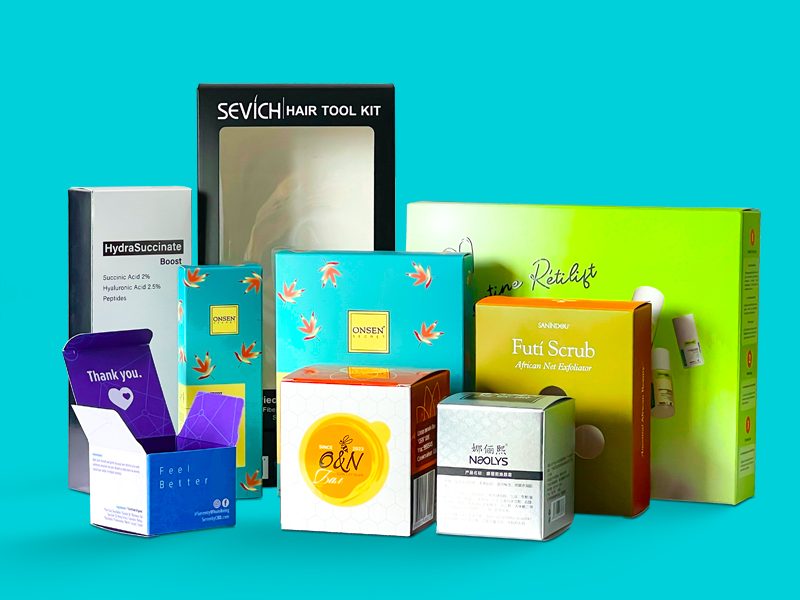
For beauty brands, the texture of high-end cosmetic packaging boxes directly determines the shelf competitiveness and brand premium of products, and the hot-stamping process is the core method to create a light luxury visual effect. With 25+ years of deep cultivation in the packaging customization industry, Shengcai has been providing high-end cosmetic gift box packaging customization services for beauty brands all year round, and has successfully produced thousands of types of cosmetic metallic hot-stamping packaging boxes. This article abandons empty theories and only shares practical cases, trial-and-error lessons and first-hand cost experience to help B-end purchasers and designers select the most suitable processes accurately.
Last year, we cooperated with an emerging lip gloss brand that planned to create rose gold gradient hot-stamping for 3,000 limited-edition gift boxes. The brand insisted on using hot stamping at first, but we predicted that hot stamping was not suitable for small-batch production with gradient patterns. After we made samples with cold foil stamping for trial, the finished products met the design requirements and the cost was reduced by 40% compared with the hot stamping plan — there is no superior or inferior process, only the one that fits the actual demand.
1. Core Principle Comparison
Hot stamping realizes pattern transfer by heating metal molds and matching with hot-stamping foil, while cold foil stamping relies on UV adhesive printing, cold foil lamination and UV curing to form metallic effects. Their core differences and our practical experience in production are as follows:
| Comparison Dimension | Hot Stamping | Cold Foil | Shengcai Practical Notes |
|---|---|---|---|
| Core Principle | Pattern transfer via high temperature and high pressure | Metallic forming via UV adhesive positioning + curing | The optimal temperature for hot stamping is 130-180℃; improper temperature will easily cause foil peeling or paper box scorching |
| Mold Requirement | Custom metal molds are needed, with higher costs for complex patterns | No special molds required, only flexographic/offset plates are needed for production | Hot stamping molds can be reused 30,000 to 50,000 times; molds for complex patterns are prone to wear and need regular maintenance and calibration |
| Minimum Line Width | Capable of forming 0.2mm ultra-fine lines stably | Only suitable for lines above 0.5mm, too fine lines are prone to foil breakage | We once made a mistake: the customer required cold foil stamping of 0.3mm lines, and the foil breakage rate reached 15% during trial production |
| Application Scenarios | Suitable for products requiring three-dimensional texture and full-page hot stamping | Ideal for designs with gradient patterns and fine overprinting requirements | Online cold foil stamping can reduce production loss, and its comprehensive loss rate is 8%-12% lower than that of hot stamping |
We once scrapped 1,000 gift boxes because we failed to check the wear of hot stamping molds in advance, which led to unclear logo stamping. Since then, we have established a strict pre-mold inspection mechanism, which has become one of our core competitive advantages in the packaging customization industry.
2. Visual Effect & Scene Adaptation
The three-dimensional concave-convex texture of hot stamping is naturally suitable for the demand of high-end large-batch cosmetic packaging. We once produced 500,000 gift boxes for an international first-line liquid foundation brand, adopting the combination of hot stamping logos and embossing processes. The finished products perfectly presented the high-end luxury texture required by the brand, and the unit production cost was reduced by 15% after mass production, which highly fit the brand positioning of international big names.
Cold foil stamping excels in presenting gradient metallic effects and fine grain patterns. For the aforementioned emerging lip gloss brand, the rose gold gradient effect realized by cold foil stamping fully met its creative design needs, and the brand subsequently entrusted us with the customization of all regular gift box packaging with cold foil stamping process. It should be noted that cold foil stamping itself cannot form a three-dimensional concave-convex feeling, but this effect can be achieved by combining it with UV embossing process, and the specific solution needs to be weighed according to the customer’s budget.
3. B-end Core: Cost & Batch Adaptation
The cost difference between the two processes is mainly concentrated in three aspects: molds, materials and production procedures, and the cost performance of the two processes changes significantly with the production batch:
- Hot stamping: It has high fixed mold costs, resulting in a high unit cost for small-batch production (less than 5,000 pieces); when the production batch reaches more than 20,000 pieces, the mold cost is amortized with the increase of output, and its cost advantage is highlighted.
- Cold foil stamping: There is no mold cost, and the unit cost for small-batch production is 30%-40% lower than that of hot stamping; for large-batch production, the cost gap between cold foil stamping and hot stamping narrows to only 5%-8%.
We once helped a beauty brand adjust the production process of 10,000 gift boxes: changing from the original hot stamping to the combination of cold foil stamping and partial hot stamping. This adjustment not only met the brand’s visual effect requirements, but also successfully controlled the budget overrun of 20%, which was highly recognized by the customer.
4. Production Efficiency & Delivery Time
The production efficiency and delivery cycle of the two processes have obvious differences, which are key factors for B-end customers to consider when placing orders:
Hot stamping requires 3-7 days for mold making and sample production, with a production speed of 2,000-5,000 sheets per hour, which is only suitable for large-batch orders with advance production planning. Cold foil stamping only needs 1-2 days for sample production without mold making, and the production speed can reach 8,000-12,000 sheets per hour, which is perfectly adapted to emergency replenishment and quick response orders in the beauty industry. Earlier this year, an emerging beauty brand had an urgent demand for 8,000 cosmetic gift boxes due to the unexpected popularity of its new products. We adopted cold foil stamping process for production, completed sample confirmation in 1 day, mass production in 3 days, and quality inspection and delivery in 1 day, and delivered all products on schedule, helping the customer seize the market opportunity in time.
5. Environmental Protection Practice & FAQ
In response to the increasingly high ESG development requirements of beauty brands, we have actively optimized the environmental protection performance of hot-stamping processes: introducing degradable hot-stamping foil for hot stamping and BOPP-free cold foil for cold foil stamping. These environmentally friendly materials not only reduce the environmental impact of packaging products, but also reduce the production energy consumption by 25% on the basis of ensuring the metallic texture of packaging, achieving a perfect balance between environmental protection and product visual effect.
In the process of docking with B-end customers, we sorted out the three most frequently asked questions about the two processes, and gave practical solutions combined with production practice:
Q1: Which process has better wear resistance for transportation and circulation?
A: Hot stamping has stronger wear and scratch resistance because the metallic foil is more closely combined with the substrate, which is suitable for beauty gift boxes requiring long-distance transportation; the wear resistance of cold foil stamping can be greatly improved after laminating the packaging surface, which is fully sufficient for daily circulation scenarios. We once helped a customer solve the problem of scratch on the cold foil stamping part of gift boxes during transportation by adding a laminating process, and the additional cost was only 5%.
Q2: Can hot stamping be applied to laminated cosmetic paper boxes?
A: Yes, but the hot stamping temperature and pressure parameters need to be adjusted appropriately (the temperature is 20-30℃ lower than that of ordinary paper boxes). We must conduct small-batch trial production before mass production to avoid laminating foaming caused by improper parameters. After summing up trial-and-error experience, we have standardized the operation process of hot stamping on laminated boxes, and the rework rate caused by such problems has been reduced to 0.
Q3: Which process is suitable for ultra-fine brand fonts below 2pt?
A: Hot stamping can stably present 0.2mm ultra-fine lines, which is the best choice for ultra-fine font hot stamping; cold foil stamping is prone to foil breakage when processing ultra-fine lines, so it is not recommended for making fonts below 2pt. We once had a customer who insisted on using cold foil stamping for 2pt ultra-fine fonts, and the foil breakage rate reached 18% during trial production, which failed to meet the mass production requirements. Finally, the problem was solved by changing to hot stamping process.
6. B-end Selection Guide & Conclusion
The core of selecting cold foil stamping and hot stamping processes for high-end cosmetic packaging boxes is to match the actual demand of the brand, and the key selection criteria are summarized as follows: choose hot stamping for large-batch high-end gift boxes pursuing three-dimensional luxury texture; choose cold foil stamping for small-batch creative packaging with gradient patterns and fine overprinting requirements; and choose Shengcai’s degradable hot-stamping material matching process for brands with high environmental protection requirements and ESG development goals.
For 12 years, Shengcai has been rooted in the packaging customization industry, relying on rich practical production experience to help numerous beauty brand customers avoid process selection mistakes, control production costs accurately and improve the visual texture of packaging products. We control the quality of the whole production process from sample design, process debugging to mass production. Whether it is large-batch high-end cosmetic gift box processing or small-batch creative packaging customization, we can tailor exclusive high-end cosmetic gift box packaging customization solutions according to the brand’s design requirements, production batch, budget and delivery time.
We are committed to helping beauty brands create high-end packaging that integrates visual beauty and cost performance, making each cosmetic packaging box a mobile business card for brand value communication. For more detailed process parameters and customized solutions, you can visit our official website for consultation.