

Core Conclusion
For winter rain, snow, and low-temperature frost environments, long-fiber kraft paper added with Wet-strength Agent is significantly superior to coated paper lamination in tensile strength and low-temperature stability. Coated paper lamination is prone to Delamination below $$0^{\circ}C$$, while the mainstream bio-based hydrophobic kraft paper in 2026 can achieve 100% degradation and maintain anti-permeability for more than 30 minutes. It also meets the latest global environmental compliance requirements, making it the preferred choice for garment paper bags in winter. With years of experience in packaging R&D, Shengcai has realized large-scale customized production of such high-performance and environmentally friendly garment paper bags.
I. Core Material Physical Performance Comparison Table: Tested in Severe Winter Environments
The test of garment paper bags in winter rain and snow is essentially a game between material physical properties and the environment. The following is a comparison of the core physical indicators of the two mainstream materials in winter practical scenarios. All data are from the latest 2026 tests by Shengcai Laboratory, for reference in procurement decisions:
| Physical Indicator | Long-Fiber Kraft Paper (with Wet-strength Agent) | Coated Paper + BOPP Lamination | Winter Practical Significance |
|---|---|---|---|
| Tensile Energy Absorption (TEA) | High (tightly interwoven fibers, TEA ≥ 12 J/m²) | Medium (relying on film support, TEA ≤ 6 J/m²) | Determines whether the bag body will burst or the handle will break when carrying heavy items such as down jackets and thick coats |
| Glass Transition Temperature ($$T_g$$) | Not obvious (resistant to extreme cold, maintaining toughness at -20℃) | Starts to become brittle around $$0^{\circ}C$$ | Determines whether “white marks” or cracks will appear at the folded parts of the paper bag, directly affecting the durability of outdoor carrying |
| Wet Strength Retention Rate | ≥75% (after 20 minutes of immersion in water) | Low (paper core softens when damp, retention rate ≤30%) | Determines whether the handle and bag body can maintain structural integrity after walking in rain and snow for 15-30 minutes |
| Chemical Compliance (2026 Standard) | PFAS-free, Monomaterial, 100% biodegradable | Contains microplastics, difficult film-paper separation, limited recycling | Directly affects the green tariff for products exported to the EU and North American markets, and is related to the brand’s environmental compliance rating |
| Low-Temperature Folding Resistance (Times) | ≥50 times (at -10℃) | ≤15 times (at -10℃, prone to film peeling) | Determines whether the paper bag is easily damaged during alternating indoor and outdoor temperatures, affecting the brand’s terminal image |
II. In-depth Analysis: Why is Kraft Paper the “All-Round Player” for Garment Paper Bags in Winter?
Many procurement managers wonder why kraft paper performs better than coated paper lamination in winter. From the perspective of paper engineering, physical chemistry, there is a clear answer——this is due to the dual advantages of fiber structure and chemical processes, and Shengcai’s customized processes have further amplified this advantage.
In terms of fiber characteristics, the core advantage of long-fiber kraft paper lies in its natural porous structure and ultra-long fiber length. The toughness of paper essentially comes from the binding force between fibers. The network formed by the interweaving of long fibers is tighter and not easy to be torn by external forces; more importantly, its fiber flexibility and glass transition temperature are suitable for winter low temperatures——the fibers of kraft paper have no obvious $$T_g$$ critical point, and even in the extremely cold environment of -20℃, the fibers will not harden and become brittle, which is the core reason for its excellent low-temperature folding resistance.
The addition of wet-strength agent has broken the shortcoming of kraft paper being “soft when wet”. The food-grade wet-strength resin added by Shengcai in the pulp stage can form stable covalent bonds with the cellulose in the paper fibers. This molecular-level locking structure will not damage the integrity of the fiber network even if water molecules penetrate into the fiber gaps. In fact, we have conducted tests: the high wet-strength kraft garment paper bag with wet-strength agent can still keep upright after being carried in moderate rain for 25 minutes, and the handle has no looseness.
In addition, the bio-based hydrophobic coating customized by Shengcai for kraft paper is even more icing on the cake. This coating changes the contact angle of the paper surface ($$\theta > 90^{\circ}$$), making rain and snow droplets roll off directly with a “lotus leaf effect” without staying and penetrating on the paper bag surface——it does not change the Monomaterial property of kraft paper, but also solves the waterproof problem, perfectly meeting the core requirements of global environmental compliance for Monomaterial and recyclability in 2026.
III. Hidden Dangers of Coated Paper Laminated Bags in Winter: Seemingly Perfect, but Actually Risky
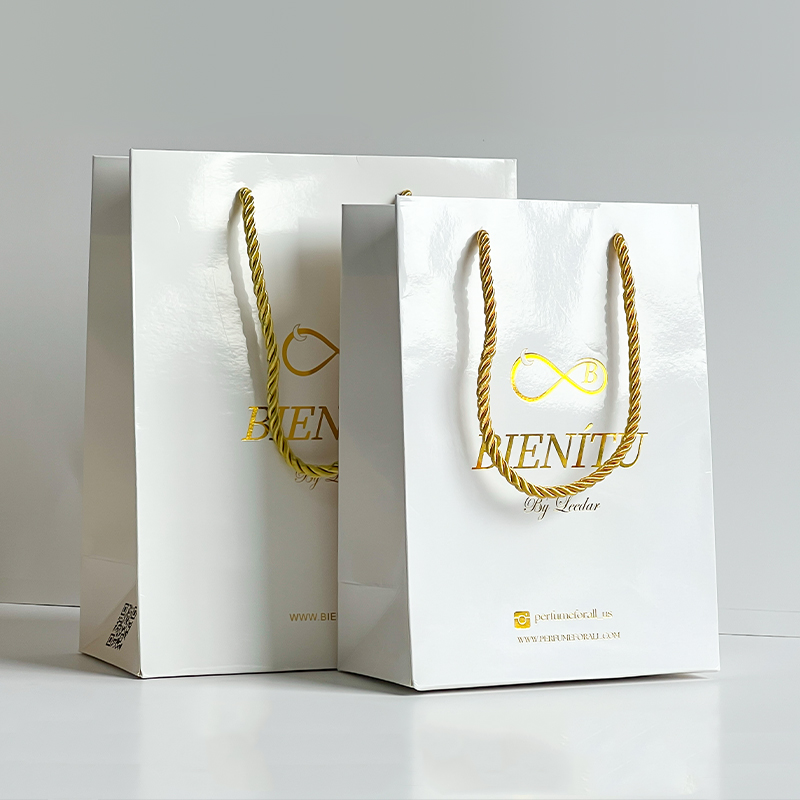
Undeniably, matte laminated coated garment paper bags have a natural advantage in visual presentation——high color reproduction, which can perfectly present the details of brand logos, and better adaptability to processes such as bronzing and UV. Therefore, they are deeply favored by high-end fashion brands. However, once entering the winter rain and snow environment, their process defects will be fully exposed, which is the core reason for the increase in winter complaints of many brands.
The most core hidden danger comes from the “compatibility” between the film layer and the paper. The copperplate paper itself has short fibers and insufficient strength, which is completely dependent on BOPP lamination for support; the glass transition temperature of BOPP film is about $$0^{\circ}C$$. Once the temperature is lower than this critical point, the film layer will harden and become brittle, and the adhesive layer between the film and the copperplate paper will lose viscosity due to thermal expansion and contraction——light cases will cause edge blistering and film peeling, while severe cases will cause the entire film layer to fall off, and the bag body will quickly soften after losing protection.
What’s more troublesome is the test of temperature difference between indoor and outdoor in winter. For example, from a store at 20℃ to outdoors at -10℃, the drastic temperature change will lead to inconsistent thermal expansion coefficients of the paper and the plastic film. The two materials shrink at different speeds, which is very easy to generate internal stress, leading to bag corner bursting and side glue overflow cracking. Even if the lamination process is improved, it can only reduce the probability of problems, but cannot fundamentally solve the defect of low-temperature brittleness.
It is more noteworthy that coated paper lamination is a composite material, not Monomaterial. The microplastics contained in the film layer are difficult to separate, which does not meet the digital tracking requirements for packaging recycling in Europe and America in 2026. It will not only increase recycling costs, but also may face additional green tariff expenditures——this is an important reason why more and more brands are abandoning laminated paper bags and turning to kraft paper materials.
IV. 2026 Garment Paper Bag Selection Guide: Optimal Solutions for Different Scenarios
Combined with the 2026 environmental compliance requirements, winter usage scenarios and brand positioning, Shengcai has sorted out targeted garment paper bag selection solutions for different types of customers, balancing practicality, compliance and brand tone:
- High-end fashion and designer brands: Prioritize pre-coated high-sensitivity special paper garment paper bags, combined with partial UV decoration. This Monomaterial solution not only retains the exquisite printing touch and delicate visual effect, but also has no risk of low-temperature film peeling. At the same time, it meets the PFAS-free environmental requirements, which is in line with the brand’s high-end and environmental positioning; if short-term rain and snow protection is pursued, Shengcai’s bio-based hydrophobic coating can be added to achieve waterproof without lamination.
- Outdoor functional and casual apparel brands: Recommend thickened high wet-strength kraft garment paper bags, combined with bio-based hydrophobic coating. The long-fiber material is durable and frost-resistant, with excellent low-temperature folding resistance, which can cope with outdoor rain, snow and low-temperature environments. At the same time, it is 100% biodegradable and PFAS-free, which is in line with the core tone of the brand’s practicality and environmental protection. Shengcai can customize exclusive texture and printing styles according to brand needs.
- Chain fast fashion brands: Optional light-coated hydrophobic kraft garment paper bags*to balance cost, practicality and environmental compliance. The Monomaterial structure is easy to recycle, the PFAS-free property meets global export requirements, and the lightweight design is suitable for large-scale procurement. At the same time, it can meet the short-term rain and snow protection needs in winter, which is the most cost-effective choice.
- High-end gift clothing matching: Recommend bronzing kraft garment paper bags, combined with wet-strength technology and hydrophobic coating. It not only retains the simple texture of kraft paper, but also improves the high-end sense through bronzing technology. At the same time, it can cope with the rain and snow test during winter gift delivery, balancing appearance and practicality, which is in line with the core needs of gift packaging.
V. 2026 Selection FAQ: Decision-Making Supplement for Procurement Managers
Combined with the most concerned issues of procurement managers in daily communication, we have sorted out the following FAQs. Combined with Shengcai’s production experience and test data, we give the most practical answers to help you avoid selection mistakes:
Q1: In addition to film peeling and cracking, are there any other hidden dangers of laminated paper bags when the temperature difference between indoor and outdoor is large in the north?
A: Yes. In addition to film-paper separation and corner bursting caused by drastic temperature differences (such as 20℃ indoors to -10℃ outdoors), the adhesive layer will lose viscosity, resulting in side glue overflow. After rain and snow water seeps into the glue overflow gaps, it will accelerate the softening of the paper bag. Even if light clothes are loaded, it may be damaged. Shengcai once solved this problem for a brand, and finally completely avoided the hidden dangers caused by temperature differences by replacing it with a Monomaterial kraft paper solution.
Q2: If pursuing high-end visual effects and wanting to avoid the low-temperature risks of lamination, is there a better alternative?
A: It is recommended to use pre-coated high-sensitivity special paper combined with partial UV decoration. This solution is Monomaterial, no lamination is required. It not only retains the exquisite printing effect of coated paper, but also has no risk of low-temperature film peeling; at the same time, it meets the 2026 PFAS-free and recyclable environmental requirements, and can reduce recycling costs. Shengcai can provide customized printing services for such special paper, perfectly matching the visual needs of high-end brands.
Q3: In addition to PFAS-free and Monomaterial, what other points need to be paid attention to for the environmental compliance requirements of garment paper bags in Europe and America in 2026?
A: There are two core points: one is the digital tracking of recyclability, which requires the paper bag material to be traceable and easy to recycle, and Monomaterial is the best choice; the other is the ban on coatings and adhesives containing microplastics, which is also the key reason why laminated paper bags are gradually eliminated. All garment paper bags produced by Shengcai meet the 2026 European and American environmental compliance standards, and can provide complete compliance test reports to help products export smoothly.
Q4: Is the cost of high wet-strength kraft garment paper bags higher than that of laminated paper bags? Which is more cost-effective for long-term use?
A: In the short term, the unit cost of high wet-strength kraft paper is slightly higher than that of ordinary laminated paper bags, but it is more cost-effective for long-term use. On the one hand, the damage rate of kraft paper bags is much lower than that of laminated paper bags, which can reduce brand complaints and secondary packaging costs caused by paper bag damage; on the other hand, it meets the 2026 environmental compliance requirements, which can avoid green tariffs and recycling costs. At the same time, it meets the environmental needs of consumers and helps improve brand reputation. According to the purchase volume, Shengcai can provide more cost-effective customized solutions to reduce long-term procurement costs.
VI. 2026 Trend Summary: Balancing Environmental Protection and Performance, Kraft Paper Becomes Mainstream
In 2026, the global demand for packaging in the clothing industry has shifted from “appearance first” to the triple consideration of “performance + compliance + environmental protection”. In winter rain and snow environments, the durability of garment paper bags directly affects the brand’s terminal experience, and environmental compliance determines the global market access qualification of products——this is the core reason why kraft paper added with wet-strength agent and bio-based hydrophobic coating has become the mainstream selection.
As a professional packaging customization manufacturer, Shengcai has been deeply engaged in the R&D and production of garment paper bags for many years. It has realized the large-scale production of PFAS-free and Monomaterial kraft paper bags. According to the brand’s positioning, usage scenarios and purchase volume, it can customize exclusive low-temperature folding, waterproof and moisture-proof solutions, providing one-stop services from paper material selection, process optimization to compliance testing.
In the final analysis, the selection of garment paper bags in winter is never a choice between “appearance” and “performance”, but a balance between durability, environmental protection and brand tone under the premise of compliance. Shengcai has always taken customer needs as the core, and used professional technology and compliant products to help you solve all pain points of winter packaging, making every garment paper bag a mobile business card of the brand.